A newer model year doesn't guarantee lower mileage. In CarScout's September 6, 2026 Mazda 3 snapshot, the 2024 row has an estimated median mileage of 41,525. The 2023 row has 34,075. That's a difference of 7,450 miles, with the newer model year showing the higher estimate.
This is a comparison within one collected sample. It doesn't establish how far all Mazda 3 owners drive, and it doesn't tell you which year to buy. It does show why model year alone is a poor substitute for checking the mileage on the car in front of you.
The public aggregate response was retrieved on September 18. Every returned row used here carries a September 6 snapshot date. The retrieval date does not make these figures a live inventory count.
The figures behind the comparison
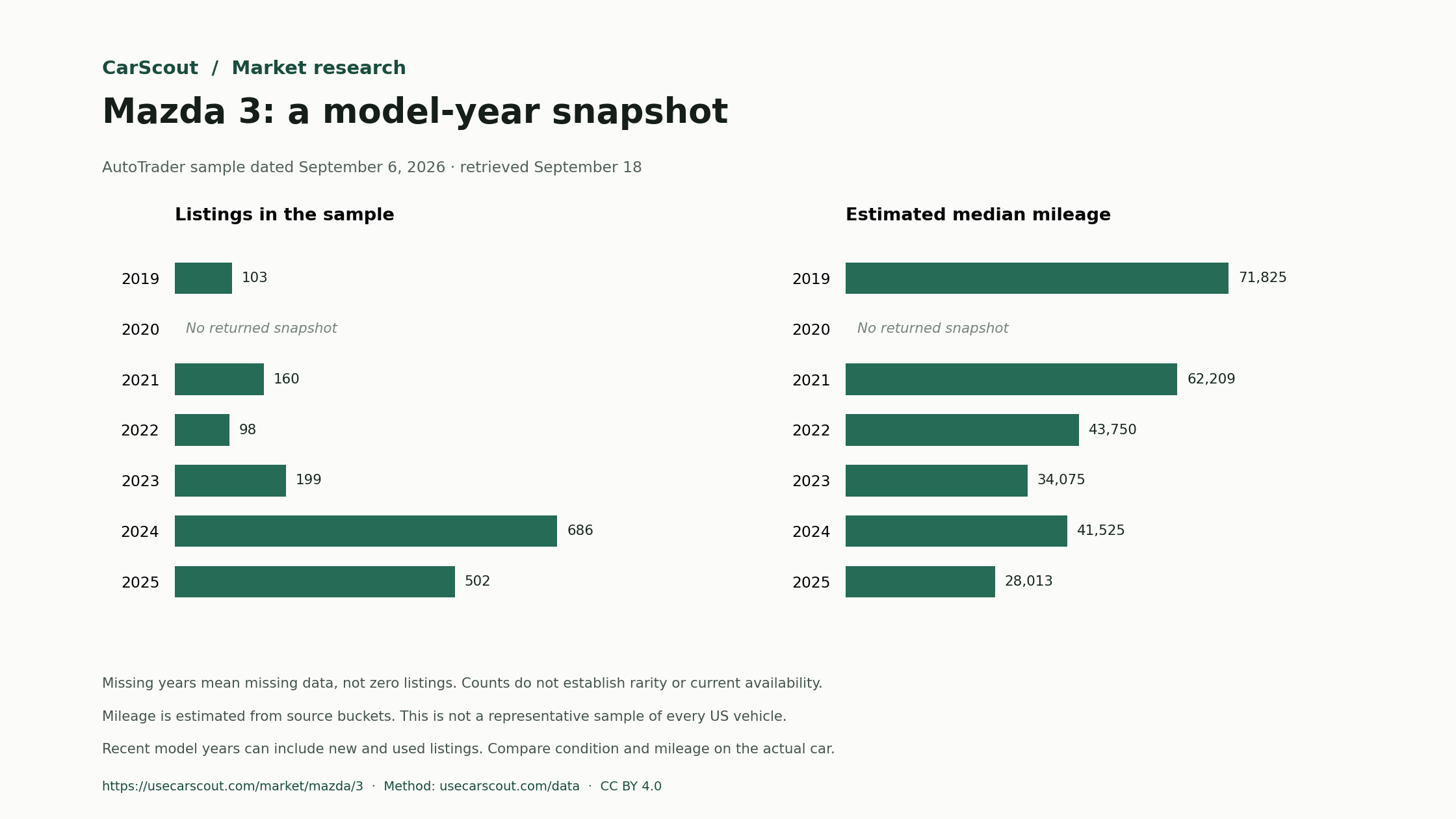
Download the aggregate rows as a CSV. The table also identifies the year that was not returned.
The request covered model years 2019 through 2025. Six year rows were returned, with listing counts totaling 1,748. The 2020 row was absent. Its count and mileage are unknown in this extract.
| Model year | Listing count in returned row | Estimated median mileage | Snapshot date |
|---|---|---|---|
| 2019 | 103 | 71,825 miles | September 6, 2026 |
| 2020 | Not returned | Unknown | No row returned |
| 2021 | 160 | 62,209 miles | September 6, 2026 |
| 2022 | 98 | 43,750 miles | September 6, 2026 |
| 2023 | 199 | 34,075 miles | September 6, 2026 |
| 2024 | 686 | 41,525 miles | September 6, 2026 |
| 2025 | 502 | 28,013 miles | September 6, 2026 |
The count total is 103 + 160 + 98 + 199 + 686 + 502 = 1,748. It sums the returned listing-count fields. It is not a verified total of distinct VINs or cars still available to purchase.
The mileage difference is 41,525 - 34,075 = 7,450. Both inputs are year-level estimates from the same snapshot date. Neither represents an individual car, and the calculation does not convert either estimate into an exact odometer reading.
What the newer-year result means
The 2023 and 2024 rows describe different groups of listings. They do not follow the same cars over time. The higher 2024 estimate therefore says nothing about annual mileage accumulation or whether one model year ages faster.
The groups also differ in size: 199 listing records for 2023 and 686 for 2024. That matters when reading the table, but it does not explain the mileage difference. The extract does not provide the detail needed to test an explanation about use, ownership, geography, or the mix of cars offered.
Don't read the result as a reason to avoid a 2024. A particular 2024 could have much lower mileage than a particular 2023. The useful action is to keep model year and mileage as separate filters, then inspect the individual candidates.
The same caution applies in the other direction. The 2025 row has a lower estimate, but that does not prove better condition or better value. Recent-year source samples can contain both new and used listings. This extract does not separate that mix.
What this sample cannot price
The returned mean-price field is unavailable for every row in this extract. There is no price comparison to calculate here. A missing price is not a zero-dollar price, and the mileage difference cannot be translated into a discount.
To compare actual asking prices, assemble candidates with the equipment and condition you need. Record the model year, mileage, asking price, and seller's confirmed availability for each. Keep a higher-mileage car in a separate comparison if it would otherwise make the cheaper option look equivalent.
The guide to comparing used-car asking prices explains how to build that comparison. The fourth-generation Mazda 3 buying guide covers vehicle selection for its stated 2019-2023 range. Neither turns this mileage sample into a valuation for a specific car.
Use the data to improve your shortlist
Before you rule a car in or out, work through these checks:
- Set the year range deliberately. Decide which years meet your equipment needs. Do not widen or narrow it solely because one snapshot has a lower mileage estimate.
- Set a separate mileage limit. Apply the limit to each listing. A year-level median cannot tell you whether that car qualifies.
- Confirm the displayed mileage. Ask the seller for a current odometer photo and check it against the listing before arranging a visit.
- Keep comparable versions together. Record the body style, trim, engine, and drivetrain. A shared model name does not make every listing interchangeable.
- Check condition and records. Mileage is one input. Review the available service history and arrange an independent inspection before a purchase decision.
- Record when you checked. Save the listing URL, VIN, and date in your own shortlist so you can tell a changed listing from an old screenshot.
If too few local cars meet the criteria, use the nationwide search guide before expanding your travel plans. A larger radius changes where you search; it does not remove the need to verify mileage or condition.
How the snapshot was prepared
These figures come from the public Mazda 3 model aggregate endpoint, retrieved September 18, 2026. The underlying public market collection uses AutoTrader data. Mileage medians are estimates calculated from source mileage buckets, so their integer precision should not be mistaken for exact observed medians.
Only returned rows within the requested 2019-2025 range appear in the calculation. All six share the same snapshot date. No value was supplied for the missing 2020 row, and no price was substituted for an unavailable field. The data methodology and Mazda 3 market page provide context; the market page can show later snapshots after this article is published.
FAQ
Does this prove a 2023 Mazda 3 is a better buy than a 2024? No. It compares estimated mileage in two sampled groups, with no usable price figures in this extract. Judge the actual car's equipment, mileage, condition, and asking price together.
Why is 2020 missing? The requested range included 2020, but the saved response did not return that year. The extract does not establish the reason. Treat it as unknown, not evidence that no 2020 cars are for sale.
Are the 1,748 listings available now? That number sums the six returned year-level counts dated September 6. It is not a live availability check or a verified count of distinct VINs. Confirm each candidate with its seller.
Once your criteria are clear, set up a Mazda 3 scout. Paid plans start at $5/week, with daily checks and digest emails when there are new matches or price drops.
Sources: public Mazda 3 aggregate response, retrieved September 18, 2026; returned snapshot dates September 6, 2026; public data methodology.