Four Miata model years returned listing counts totaling 261 in CarScout's September 6, 2026 snapshot. Four other years in the requested range returned no row. Those missing years are unknown in this extract. They are not proof that the cars have disappeared from sale.
That distinction matters if you're choosing a year range for a used MX-5 search. A small count can tempt you to call a year rare. An absent row can tempt you to drop it from your search entirely. This sample supports neither conclusion.
The request covered 2016 through 2023. The response was retrieved on September 18, but the returned rows are dated September 6. It describes a collected sample, not a search of every Miata available today.
The returned years and the gaps
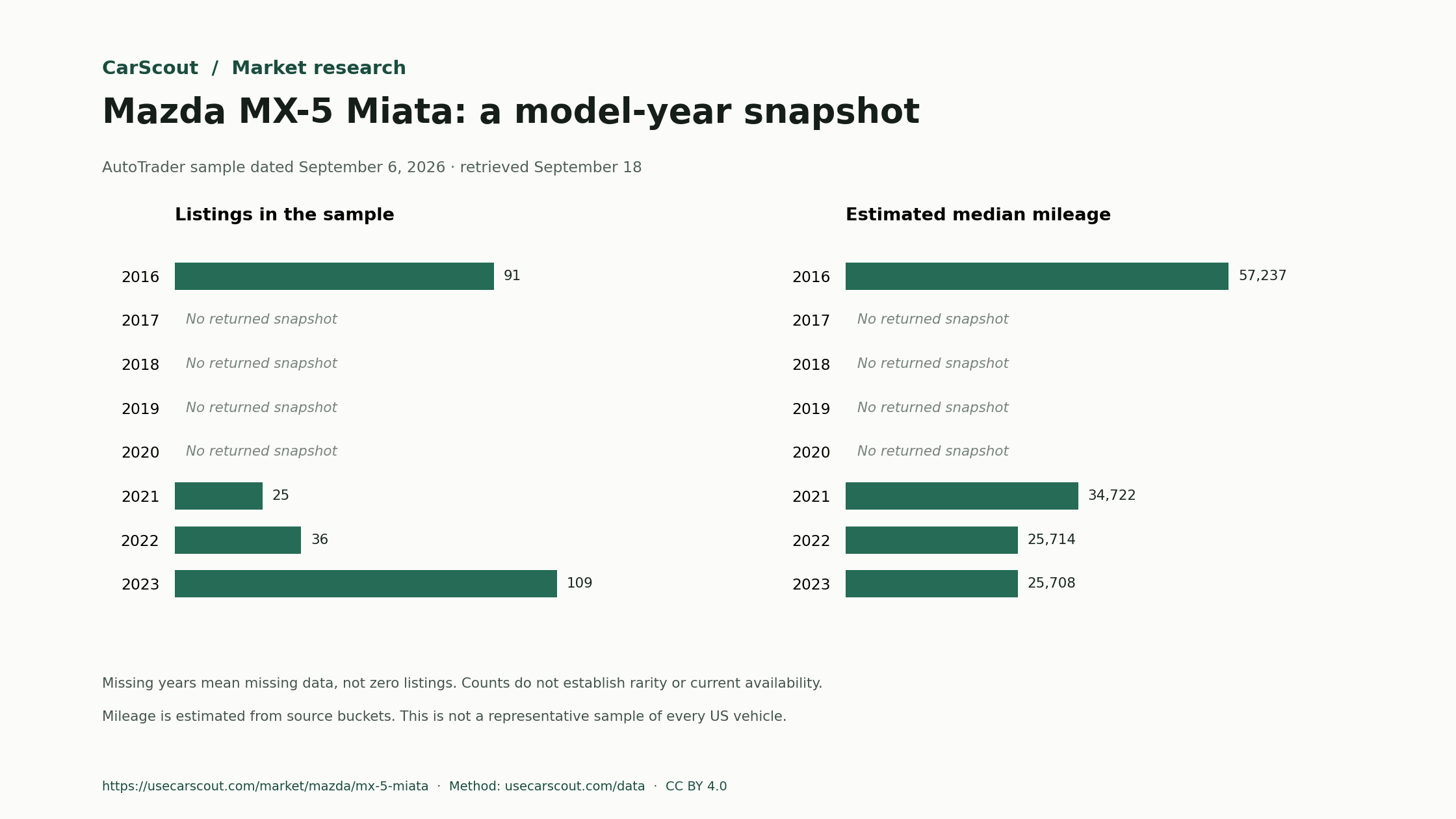
Download the aggregate rows as a CSV. The table keeps the missing years visible alongside the returned rows.
The sample returned rows for 2016, 2021, 2022, and 2023. Every listed mileage value is an estimated median derived from source mileage buckets.
| Requested model year | Listing count in returned row | Estimated median mileage | Snapshot date |
|---|---|---|---|
| 2016 | 91 | 57,237 miles | September 6, 2026 |
| 2017 | Not returned | Unknown | No row returned |
| 2018 | Not returned | Unknown | No row returned |
| 2019 | Not returned | Unknown | No row returned |
| 2020 | Not returned | Unknown | No row returned |
| 2021 | 25 | 34,722 miles | September 6, 2026 |
| 2022 | 36 | 25,714 miles | September 6, 2026 |
| 2023 | 109 | 25,708 miles | September 6, 2026 |
The arithmetic is 91 + 25 + 36 + 109 = 261. That is a sum of returned listing-count fields across those four years. It is not a verified count of distinct VINs, an exhaustive count for the generation, or proof of current availability.
The 2023 row contains the largest count among the returned rows. The 2021 row contains the smallest. Those are descriptions of this extract. They do not rank nationwide availability across all eight requested years, because half the years have no returned observation.
Missing is different from zero
A zero count would be an explicit observation. Here, the missing years have no row in the saved response, so there is no count to read. Replacing those gaps with zero would create information the source did not supply.
It would also change the story. A chart with four zero bars would suggest the collection observed no listings for 2017 through 2020. A table that says “not returned” correctly leaves the question open. This article uses the second approach.
The response does not establish why those rows are absent. Do not turn the gap into a claim about demand, production volume, owners holding onto their cars, or a sudden shortage. Each explanation would need separate evidence.
For a shopper, the practical result is straightforward: retain any missing year that otherwise meets your requirements. Check current listings for it. A reporting gap is not a vehicle-selection rule.
What the mileage figures add
The returned 2022 and 2023 mileage estimates are 25,714 and 25,708 miles. Their six-mile difference should not drive a buying decision. These are bucket-based estimates for different samples, not precise measurements of two otherwise identical cars.
The 2016 estimate is higher at 57,237 miles, but that does not establish the condition of a particular 2016. Nor does it show a mileage trend over time. A trend needs repeated observations; this table contains one snapshot date.
Use mileage as a candidate-level filter. If your limit is 40,000 miles, check the odometer reading of each listing against that limit. The 2016 group estimate does not show that every 2016 fails it. The 2021 estimate does not show that every 2021 passes it.
All returned mean-price fields were unavailable in this extract. There is no basis here for a price ranking, a depreciation calculation, or a claim that a low-count year deserves a premium.
Build a search that survives incomplete data
Start with the car you need, then use aggregate data as context. The ND Miata buying guide covers vehicle selection for 2016-2023. If you're considering an earlier car, read the NC Miata guide separately rather than combining the generations into one comparison.
For each candidate, keep a short record:
- Model year and specification: Include the transmission, trim, roof type, and equipment you require. Verify important details with the seller.
- VIN and listing URL: Use the VIN to recognize the same car when it appears on more than one site.
- Mileage and condition: Record the listed mileage, request a current odometer photo, and leave room for inspection findings.
- Asking price and quote date: Compare similar candidates using prices checked at roughly the same time.
- Availability confirmation: Ask whether the specific car is still available before planning a visit.
- Reason for rejecting it: Keep a car that fails your specification separate from a car that simply lies outside your initial radius.
That last distinction helps when the shortlist is thin. If distance is the constraint, the nationwide used-car search guide gives you a process for expanding the search. If price is the constraint, use the asking-price comparison guide. Neither requires assuming that a missing model-year row means zero cars.
Method and source limits
The source is the public MX-5 Miata model aggregate endpoint, retrieved September 18, 2026. The underlying public market collection uses AutoTrader data. The calculation includes only returned rows within 2016-2023, all dated September 6.
The extract does not establish unique-VIN counts, source coverage for every year, or availability at publication time. It also does not split the sample into every combination of roof, transmission, trim, location, and condition. Those details belong in your candidate checks.
See the data methodology for collection context and the MX-5 Miata market page for the public aggregates. Later page updates can differ from this dated extract.
FAQ
Does the missing 2019 row mean there are no 2019 Miatas for sale? No. It means the saved response did not return a 2019 observation. Check current listings and confirm availability with sellers instead of treating the gap as zero.
Is a 2021 Miata rare because this sample counts 25 listings? This count cannot establish rarity. It reflects one returned year-level sample, with no complete nationwide denominator or verified count of distinct available cars.
Can I use these figures to decide what to pay? The extract has no usable mean-price figures. Use comparable current candidates and their condition to assess asking prices; don't infer a premium from a small count.
To keep checking your chosen criteria, set up a Miata scout. Paid plans start at $5/week and deliver daily digest emails when there are new matches or price drops.
Sources: public MX-5 Miata aggregate response, retrieved September 18, 2026; returned snapshot dates September 6, 2026; public data methodology.